Artificial intelligence is often associated with automated sorting, standardization, and even a certain dehumanization of interactions.
Yet, in recruitment, AI can have the opposite effect: it frees up time spent on repetitive and technical tasks, allowing recruiters to focus on the more human side of interactions.
At Ametra, HR teams observe two concrete advantages in particular: more efficient sourcing (less energy wasted on complex searches) and a more personalized candidate approach (without starting from scratch for every message).
The result: less “mechanics” and higher quality in the relationship.
AI does not replace the recruiter: it frees up their time and bandwidth for candidates.
Recruiting is not just about “finding a CV.”
It is about understanding a need, translating on-the-ground reality, assessing motivation, detecting career path consistency, answering questions, providing reassurance, and building a connection. In short: it is a profession of precision and discernment.
However, a large part of a recruiter’s time can be consumed by highly technical steps: building queries, managing profile volumes, following up, drafting messages, and juggling multiple tools.
This is precisely where AI becomes useful: it facilitates part of this work to make more room for the relationship.
Faster and often higher-quality sourcing
Moving from Boolean queries to natural language searches
For a long time, effective sourcing required mastering complex, typically “Boolean” searches (using quotation marks, parentheses, operators, etc.), with a potentially very frustrating margin for error.
Forgetting quotation marks in a job title (e.g., “mechanical engineer”) can broaden the search uncontrollably and produce unusable results.
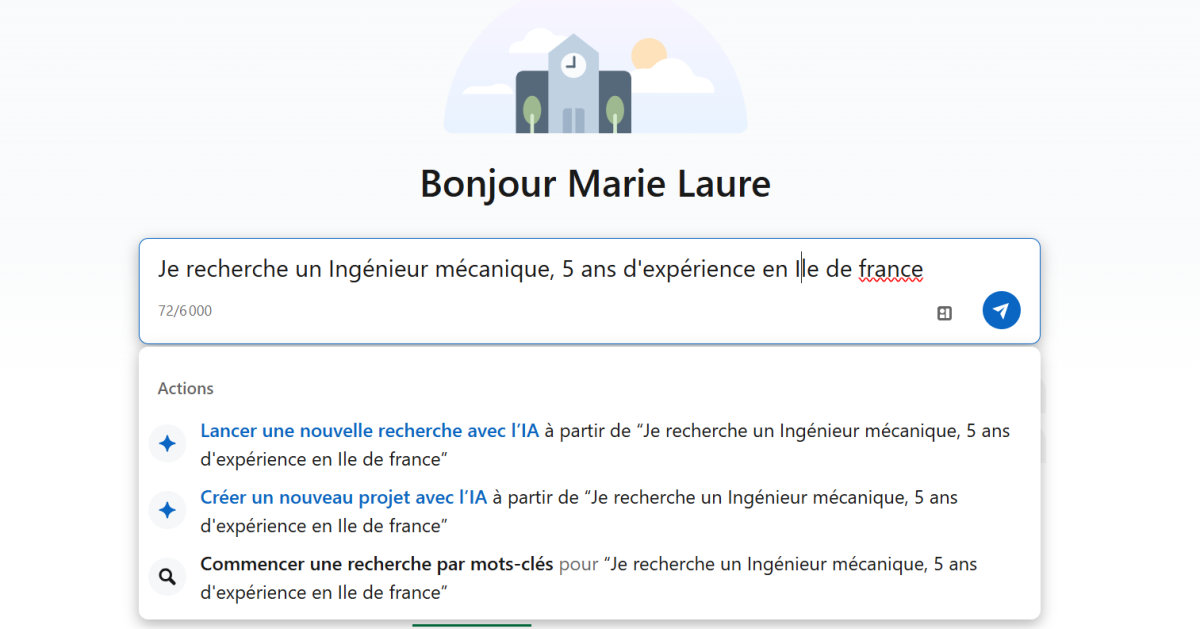
Recent tools integrating AI, particularly on LinkedIn Recruiter, now allow searches to be launched using natural language phrases: “I am looking for a mechanical engineer, 5 years of experience, in region X, mobile / already on-site”. Searching becomes more intuitive, more accessible, and above all, more reliable.
This evolution also changes the learning curve: a junior recruitment profile can manage quickly without having to immediately master the subtleties of an advanced query. Here, AI acts as a “safety net” while accelerating tool adoption.
The recruiter remains in control: filters, adjustments, and prioritization
An important point: AI search is not static. It combines with traditional filters and the recruiter’s expertise. You can gradually refine by specific geographic area, schools, current or past companies, or even mobility type.
In practice, the benefit comes not only from time saved but from the quality of the results from the start.
When noise is reduced more quickly, time is recovered to do what matters: actually reading career paths, understanding transitions, spotting weak signals, and selecting profiles that make sense for the position and the team.
Better covering the reality of job titles (and avoiding missing out on good profiles)
Another major contribution: AI helps to overcome the rigidity of job titles. In certain professions, the same position can be listed in ten different ways: anglicisms, sector variations, internal titles, role evolutions… a search that is too strict risks setting aside relevant profiles.
AI modules are capable of suggesting title variations to include in the search, allowing for an intelligent expansion of the scope. This is particularly useful for roles where titles vary significantly and where the recruiter must deal with very different conventions depending on the company.
A more human candidate approach… because it can be more personalized
AI as a first draft, not as the final message
The second major use, often underestimated, concerns the candidate approach. On LinkedIn, AI can generate an InMail proposal based on the profile being viewed.
The point is not to send an automatic and generic message, but to have a first draft that incorporates key elements of the career path to relevantly refine the factors to consider when contacting the candidate in a way that is compatible with their background.
Then, it is up to the recruiter to do what the machine cannot: inject context, tone, the reality of the position, and what makes the opportunity attractive.
In practice, AI facilitates the start, but the quality comes from the human.
In an over-solicited market, the difference lies in accuracy
The reality on the ground is simple: many candidates receive a huge number of solicitations. They do not respond to everything, and that is quite normal. To stand out, you must be clear, targeted, respectful of the other person’s time, and able to generate interest in just a few lines.
Properly used, AI does not “dehumanize”: it allows the recruiter to devote more energy to real personalization, argumentation, and follow-up. In other words, it can contribute to a higher-quality relationship because it removes part of the operational fatigue.
LinkedIn, HelloWork… complementary uses depending on needs
At Ametra, tools are not limited to a single platform. LinkedIn remains a central environment for sourcing and outreach, but job boards like HelloWork also integrate AI-assisted search features, notably to simplify the transition from a “technical” search to a natural language search.
In practice, this diversity is useful: for certain high-demand professions, it is difficult to afford using only one channel. The goal is not to multiply tools, but to increase the chances of finding the right profiles while streamlining the time spent searching.
Limitations: AI helps, but it does not understand everything
Making recruitment more human also means being clear-eyed about the limitations.
For example, AI can interpret experience based on imperfect clues (dates, degrees, latest roles). It may miss atypical profiles or relevant career changes if the information is not structured as expected. And, above all, it never replaces the key step: studying the profile and the human assessment of consistency, motivation, and potential.
Another often forgotten point: the effectiveness of these tools also depends on the quality of the information available. A profile with very little information, or one that is too vague, will not show up as well.
There is a form of “give-and-take” here: candidates who clearly describe their skills and keywords also increase their chances of being identified.
Ultimately, AI gives back time where the value is human
AI does not replace the recruiter: it helps them recruit better.
By simplifying sourcing and facilitating the candidate approach, it frees up time for what makes the difference: building the relationship, a detailed understanding of career paths, and candidate support.
Used with discernment, it can become a tool in the service of more human, targeted, and efficient recruitment.