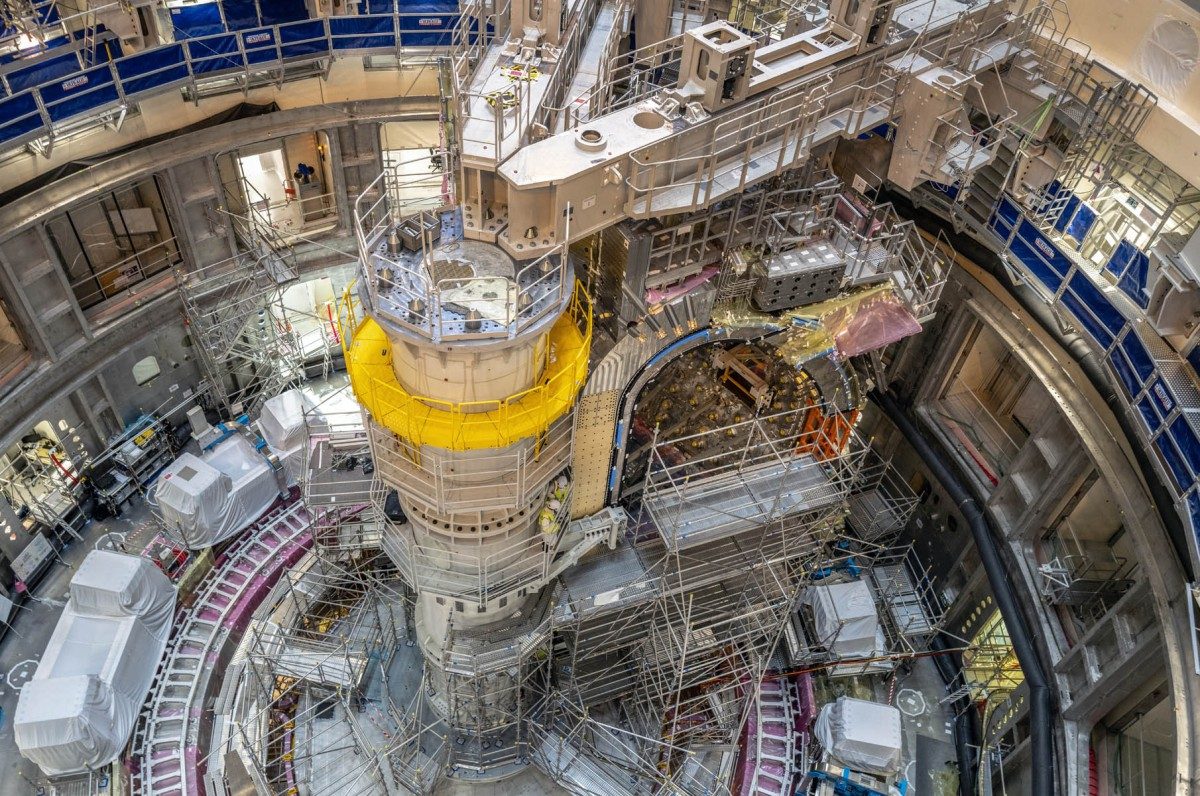
ITER is the world’s largest project dedicated to nuclear fusion, a clean and virtually inexhaustible energy source. Located in Cadarache, in the Southeast of France, it brings together 35 countries and mobilizes thousands of scientists and engineers around an unprecedented goal: demonstrating the feasibility of fusion as an energy source. The advances of 2025 mark a new stage in the construction of the immense experimental tokamak and confirm the momentum of this extraordinary project. Technical Milestones Already Achieved and 2025 Stages Among the significant milestones already reached is the insertion of the first vacuum vessel sector, carried out with millimeter precision in the spring of 2022. This monumental enclosure, composed of nine sectors weighing several hundred tons each, is the heart where the plasma will take shape. In 2025, a symbolic milestone is reached with the completion of the central solenoid, a superconducting magnet weighing nearly 1,000 tons and standing 18 meters high, capable of generating a magnetic field of 13 teslas. This solenoid will play an essential role in the confinement and stabilization of the plasma. These advances are part of a revised schedule: the first plasma is now expected by 2034, followed by the deuterium-tritium phase around 2039–2040. In February 2025, the CEA’s WEST tokamak broke a world record by maintaining a plasma for more than 22 minutes. This feat far exceeds previous performances and demonstrates progress in mastering plasmas over long durations. Already in 2024, WEST had established a record of 6 minutes in high-performance mode, which validated ITER’s technological choices, particularly the use of tungsten walls. Beyond these technical milestones, ITER remains a colossal project: its total cost is now estimated between 20 and 25 billion euros (compared to 10 billion at its launch). The European Union finances approximately 45% of the project, with other partners sharing the remainder (United States, China, India, Japan, South Korea, Russia). This distribution reflects the strategic and geopolitical dimension of the international cooperation surrounding ITER. Heating the Plasma: Three Complementary Methods To initiate fusion, the plasma must be heated to approximately 150 million degrees Celsius, which is nearly ten times the temperature at the core of the Sun. To reach this extreme temperature, three heating methods are combined: © ITER “The ITER tokamak will combine three external heating sources to bring the plasma to the temperature required for fusion: neutral beam injection (right) and two sources of high-frequency electromagnetic waves—ion and electron cyclotron heating (left, in blue and green).” These cutting-edge technologies are essential for initiating and maintaining the fusion reaction. Ametra’s Commitment to ITER For more than twelve years, Ametra has put its expertise in mechanical engineering and complex systems at the service of the project. In 2025, our teams are mobilized on several critical fronts: Our employees are working on two of the three main antennas, which are essential for reaching the necessary 150 million degrees: “We are entering a new phase: after several years of studies, we are moving to concrete implementation. This is a key stage of the V-cycle, and collaboration with foreign manufacturers is proceeding very smoothly.” Florian Luiggi, Agency Manager within the Ametra Group One of Ametra’s experts is integrated into the ITER platform to support the contractual and technical management of complex files. This activity is essential for securing the project and streamlining coordination between stakeholders. “Claim management is not a mission we frequently perform, but here, it is indispensable. It allows us to frame the project and ensure technical and financial consistency between the various participants in an international environment.” The nine sectors of the vacuum vessel must be welded with extreme precision. Alongside Westinghouse, which is in charge of welding the vacuum enclosure, Ametra designs the mechanically welded and mechanically bolted structures used to introduce and position the welding robots, while ensuring operator safety. © ITER Designing structures capable of guiding robots in such a constrained space is an exciting challenge. It requires precision and a very rigorous engineering approach. We also contributed to the study of the CPRHS, a rail-based handling system that allows a shielded container to collect irradiated components and then transfer them to the hot cell for reprocessing. A Shared Global Ambition ITER is not just a scientific project: it symbolizes unprecedented international cooperation. The 35 countries involved include the 27 members of the European Union (via Euratom), the United Kingdom, and Switzerland, as well as China, India, Japan, South Korea, Russia, and the United States. For Ametra, this international dimension is a prime field of expression. Our teams mobilize their expertise on critical systems requiring precision, innovation, and rigor within a global collaborative environment. Our previous experience on the Tore Supra tokamak also provides a valuable foundation for addressing ITER’s challenges, particularly regarding heating systems and thermal constraint management. Each milestone reached brings the scientific and industrial community closer to the ultimate goal: producing ten times more energy than was injected to initiate the fusion reaction (Q ≥ 10). A prospect that, in the long term, could permanently transform the global energy supply. Would you like to learn more about the Ametra Group’s expertise ? Visit our official website now. We are also on LinkedIn! © ITER – main image:
How Ametra supports the evolution of the Laser Mégajoule
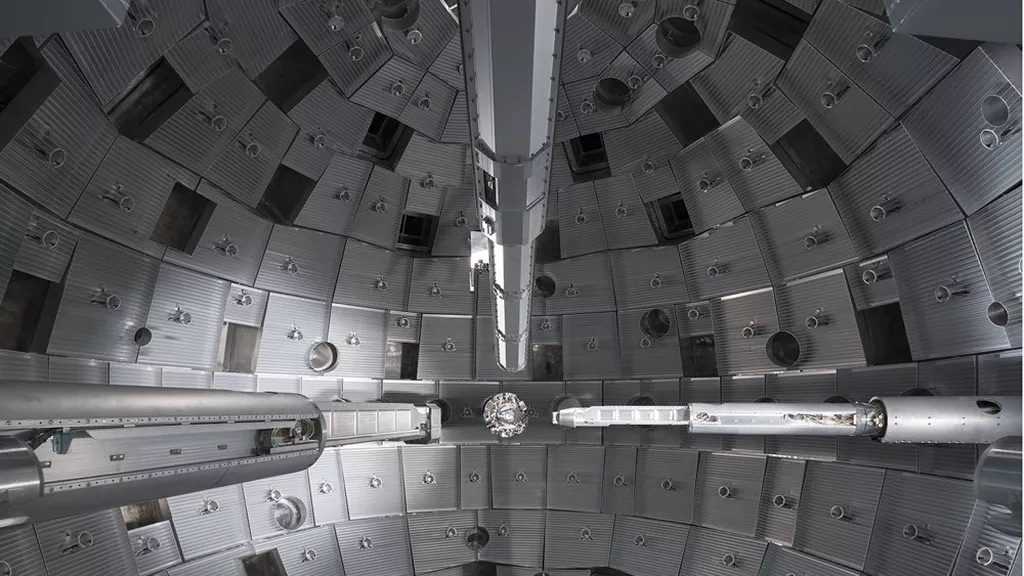
In Barp, near Bordeaux, the Laser Mégajoule (LMJ) is central to France’s strategy for laser fusion and nuclear simulation. Year after year, firing campaigns intensify, diagnostics improve, and the support of the PETAL laser opens up unprecedented observation avenues. Within this evolving framework, Ametra is strengthening its presence alongside the CEA, through an integrated platform combining mechanics, electricity, and utilities, complemented by enhanced cross-functional coordination and direct simulation support. With the new AIEL2 contract, this involvement expands to new areas and forms part of a long-term partnership. The LMJ: A Unique Scientific and Strategic Project The Laser Mégajoule is the French equivalent of the American National Ignition Facility (NIF). Its principle: concentrating the energy of 176 laser beams onto a millimeter-sized target to recreate, for a fraction of a second, extreme conditions of temperature and pressure comparable to those found at the heart of stars. Originally designed to be expandable to 240 beams, the LMJ already achieves the required performance for its current campaigns with 176 beams. In October 2019, a first fusion experiment with 48 beams marked a significant milestone. The results confirmed the reliability of the Simulation program and validated the facility’s performance. Experiments also rely on cryogenic deuterium-tritium (DT) micro-targets, maintained at approximately 20 kelvins. Manufactured and prepared at CEA Valduc, they are then transferred to Barp in an uninterrupted cold chain. Mastering this technology, which is as demanding as it is strategic, represents key expertise for laser fusion. The LMJ thus pursues two major missions: Finally, research on targets is continuously progressing: composition, geometry, and surface quality are all crucial parameters for improving energy yields and moving closer to ignition. LMJ-PETAL Campaigns: Focusing on Precision Since 2022, the LMJ has intensified its campaigns to explore new firing schemes and varied target configurations. The coupling with PETAL, which delivers ultra-short petawatt power pulses, plays a decisive role: it generates X-rays or particles that radiograph the implosion in real-time and reveal the dynamics of dense plasmas at the critical moment. © Mathias Scandura – CEA The teams have also optimized PETAL-driven X-ray backlighters, capable of producing very high-resolution radiographs of implosions. Concurrently, a new generation of streak tubes is under development. These ultra-fast cameras, sensitive to picosecond-scale phenomena, will significantly improve measurement resolution and dynamics. The LMJ – PETAL system is also open to the academic community through regular calls for projects. A user guide defines the technical framework (diagnostics, procedures, planning) and supports multi-year programs. This openness helps strengthen the scientific attractiveness of the French platform in a field where global competition is intense. Expanding the Ecosystem In 2025, GenF (Thales Group) announced an R&D program on laser fusion that will, starting in 2027, rely on campaigns conducted at existing infrastructures such as the LMJ. This initiative marks a new opening towards the private sector and illustrates the LMJ’s growing attractiveness for both public and private research. On the international stage, the results obtained in the United States (ignition achieved and then repeated) now serve as benchmarks and accelerate the global roadmap. The LMJ contributes to this dynamic with its own specificities: its 176 beams, the unique contribution of PETAL for diagnostics, and constant attention to the quality of micro-targets. Renewal of the AIEL Contract: A New Dynamic In April 2024, the AIEL (Assistance for Engineering and Operation of the LMJ) contract was renewed for seven years. This new contract, named AIEL2, was again awarded to the consortium of TechnicAtome and Egis. Compared to the first edition, its scope has been expanded: it now covers support for the facility’s ramp-up, finalization of the assembly of the 22 laser chains, maintenance, transition to the nuclearization phase, as well as strengthened aspects of safety and security. From a Dual Platform to a Single Integrated Platform Under AIEL1, two distinct platforms coexisted: a mechanical platform and an electrical platform. With AIEL2, these scopes have been merged into a single platform covering mechanics, electricity, and utilities (fluids, ventilation, etc.). This integrated platform now brings together 16 Ametra employees, within a harmonized organization. “Ametra’s strength lies in having expertise in both mechanics and electricity, and thus effectively managing the cross-functionality of studies.” – Kevin Lapierre, Head of Studies Group (Bordeaux Agency) The implementation of this single platform has led to the harmonization of working methods and strengthened activity monitoring. The creation of a cross-functional studies coordinator position ensures overall coherence and facilitates exchanges. An Opening Towards Calculations Another novelty of AIEL2: the full-time integration of calculations on-site. Ametra Simulation now assigns a dedicated engineer within the platform. This additional expertise allows us to cover the entire chain, from mechanical and electrical studies to advanced simulation. More Synergies, More Responsibilities With AIEL2, new companies have joined the system. The range of activities entrusted to the consortium has expanded, increasing the need for synergies between platforms and closer coordination. Ametra responded to this challenge by implementing a service center management plan that integrates the specificities of each area, while respecting CEA and TechnicAtome standards. The revised service catalog was cascaded down to our teams, accompanied by regular meetings (workload and progress reviews) to harmonize practices and reporting. “We have rethought our way of working, integrating cross-functionality from the design stage. Today, we have the capacity to manage cross-functional topics that require strong interactions between mechanics, electricity, and utilities.” – Kevin Lapierre A Long-Term Commitment For over ten years, Ametra has supported the CEA on the Laser Mégajoule. From initial mechanical and electrical assistance to the integration of simulation, our role has progressively expanded. The AIEL2 contract, concluded for seven years, offers a perspective of stability until 2031 and confirms the renewed trust of the CEA and its partners. Beyond this framework, this continuity illustrates Ametra’s ability to evolve with its clients’ needs, mobilize new expertise, and strengthen cooperation among its teams. In Conclusion The LMJ remains, in 2025, a unique scientific and strategic facility, at the crossroads of fusion research and national defense. With AIEL2, Ametra takes a new step and confirms its