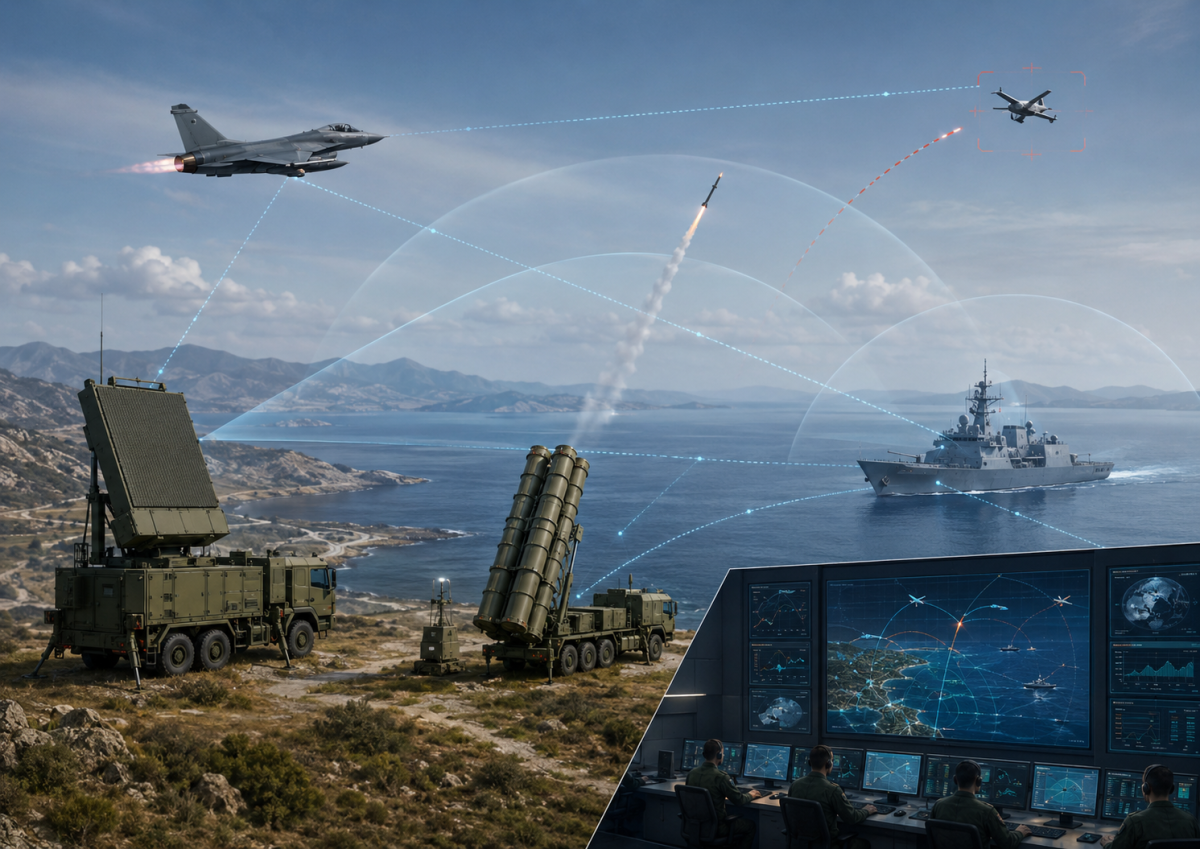
Low-cost drones, cruise missiles, ballistic vectors, hypersonic threats, jamming and cyberattacks: air defence can no longer be reduced to a duel between radar and missile. It is played out on the ground, in the air, from the sea, but also across command networks, test capabilities and the industrial capacity to produce, qualify and sustain complex systems. A ground–air–sea continuum to integrate NATO now describes integrated air and missile defence as a capability covering the full spectrum of aerial threats, from drones to ballistic and hypersonic missiles. This shift calls for a distributed architecture: fixed and mobile radars, optronic sensors, air-defence frigates, fighter aircraft, short-, medium- and long-range ground-to-air systems, electronic warfare assets and interoperable C2 centres. (NATO) The challenge, therefore, is not only to have high-performance sensors or effectors. It is about fusing heterogeneous data, prioritising threats, avoiding redundant shots, preserving communications and maintaining controlled decision-making within a very short timeframe. At European level, initiatives such as the European Air Shield and the European Drone Defence Initiative, set out in the European defence roadmap to 2030, reflect this search for a coordinated response. The naval dimension plays a structuring role: a surface combatant can extend the detection bubble, protect a coastal area and share its tracks with land and air assets. (Defence Industry and Space) Saturation changes the industrial equation Recent conflicts have confirmed a key point: a credible defence must be able to absorb saturation. A low-cost drone can force the use of a far more expensive interceptor; a salvo may seek to exhaust stocks; a combined attack can mix decoys, jamming and multiple trajectories. For industry, the challenge becomes twofold: increase performance, but also reduce unit cost, simplify maintenance and accelerate production. This directly brings up ramp-up, supply chain and obsolescence issues. Electronic sub-assemblies, computers, FPGA boards, power supplies, antennas, actuators, data links and test benches must be secured over time. Qualification chains must also keep pace: environmental testing, EMC, software validation, embedded cybersecurity, component qualification and technical documentation usable for in-service support (MCO). This industrial robustness determines real availability: a high-performance system that is difficult to maintain, test or supply weakens the entire posture. Innovative solutions, but qualified The expected innovation is not limited to interceptors. It also concerns multifunction radars, data fusion, decision-support AI, open architectures, directed-energy effectors, counter-drone solutions, digital twins and simulation capabilities. The objective is clear: detect earlier, decide faster, engage at the right cost and reconfigure systems in the face of evolving threats. It is precisely on these engineering building blocks that Ametra and its partners can contribute: mechanical and electronic design, equipment industrialisation, software development, cybersecurity, test benches, system validation, documentation, configuration management and life-cycle support. Recent posts on the Ametra blog about future defence programmes also remind us that meaningful autonomy depends less on an isolated object than on coherence between sensors, payloads, links, command and support. (Ametra Group) Conclusion: building technological endurance For Europe, air defence has become an issue of industrial sovereignty as much as security. The answer will not come from a single system, but from a coherent, interoperable and sustainable set, capable of operating from the ground, the air and the sea. In this context, the value of engineering lies in execution: turning innovation into qualified capabilities, produced at a controlled rate and sustained over time. To learn more about Ametra Group’s expertise and our references, visit our official website. We are also on LinkedIn!
Supporting the Nuclear Revival: Rigor, Expertise, and Proximity
“Reviving nuclear power is not reinventing the wheel: it’s reproducing what works, with safety as the primary principle.” An Unprecedented Industrial Revival Context On February 10, 2022, in Belfort, President Emmanuel Macron announced the construction of six EPR2 reactors and the study of eight additional ones. This speech, part of the national strategy for reindustrialization and energy sovereignty, marked a turning point for a sector that had been dormant for several decades. With the exception of the Flamanville 3 project, launched in 2007 and entering its final commissioning phase in 2024 after more than ten years of delay, France had not built a new reactor since the late 1990s. As a result, industrial and technical expertise has diminished, a direct consequence of decades of underactivity and disinvestment in the sector. Parliamentary reports (Senate/OPECST, Cour des comptes) confirmed this loss of skills linked to underactivity and the decline in the number of specialized engineers trained in the nuclear field. The example of the Melox plant (Gard), operated by Orano and dedicated to the manufacture of MOX fuel, has become symbolic: the company recognized the need to rebuild skills for certain critical operations. More broadly, the winter of 2022–2023 acted as an electroshock: up to 32 out of 56 reactors were shut down, revealing the vulnerability of an aging fleet and the urgent need to revive the sector to ensure national energy autonomy. This revival goes beyond the mere construction of EPR2s: it involves the entire chain, from the fuel cycle to maintenance, including training and the ramping up of subcontractors. Mastering the Existing Rather Than Innovating at All Costs Manufacturers today share a common conviction: it is better to reproduce perfectly than to seek to reinvent at all costs. In a sector where safety is a priority, innovation only makes sense if it is controlled. The EPR2 project perfectly illustrates this idea: it simplifies and enhances the reliability of the first EPR’s design, whose complexity had generated considerable cost overruns and delays. Currently, Ametra Group’s clients expect our experts to be able to reproduce what works, without unnecessary risk-taking. The challenge is rigor: zero surprises, zero deviations. Sustainability-Resilience, Future Back-End…: Major Nuclear Programs Underway The French revival is currently structured around several key programs: These projects share the same logic: preparing for the future without weakening the present, by ensuring the operational continuity of the existing fleet and plants while launching tomorrow’s infrastructure. Ametra, a Historical Partner in French Nuclear Power Ametra is one of the few engineering players to have never left the nuclear sector. Even during periods of slowdown in the industry, the company continued to invest in it, which allowed it to maintain a foundation of skills and safety processes, now a major asset. Ametra’s calculation office has indeed dedicated 50 to 60% of its activity to nuclear power for decades, with in-depth mastery of the sector’s specific codes and standards. This continuity has allowed the company to preserve a true nuclear culture, a decisive asset at a time when the sector is recruiting massively. Ametra is also compliant with the requirements of ISO 19443, the international quality standard dedicated to nuclear power, already adopted by several major players in the sector. Geographic Proximity and On-Site Support Supporting manufacturers also means being present as close as possible to key sites.Ametra has thus strengthened its presence in major nuclear activity basins: Support also means being “where it happens.” Our teams are on the ground, in direct contact with manufacturers, to ensure responsiveness and technical consistency. A Necessity: Transmitting and Capitalizing on Nuclear Expertise The nuclear revival cannot succeed without intergenerational transmission. At Ametra, this logic is based on structured skills transfer: the most experienced engineers (some with over twenty years in nuclear) mentor new recruits to pass on safety reflexes and documentary rigor. This model is all the more strategic as the sector currently faces a shortage of qualified talent. According to the GIFEN and the Ministry of Labor, the sector will need to recruit 10,000 to 15,000 new professionals per year over the coming decade, almost double the current number of graduates. Ametra contributes to this collective effort by supporting profiles from other industrial sectors: special machines, pressure equipment, agricultural machinery, heavy industries… These engineers, already familiar with robustness and traceability requirements, then acquire the “nuclear layer” through internal training. Industrial Rigor Serving Nuclear Power In nuclear power, safety is not just a protocol: it’s a shared culture at all levels of the project. As an Ametra manager reminds us, “even someone installing a screw must understand why they are installing it and how their action contributes to overall safety.” Within the group, this requirement is expressed through three complementary pillars: This approach anchors safety in the long term: it relies not only on regulatory compliance but on a collective mindset, shared by all Ametra teams and its partners. Ametra, a Key Partner in the French Nuclear Revival By participating in major programs such as EPR2, Future Back-End, Sustainability-Resilience, and the SNLE 3G / S3G, Ametra actively contributes to the reconstruction of the French nuclear sector. This contribution is based on clear fundamentals: rigor, expertise, proximity, and continuity. True to its industrial culture, Ametra stands out as a reliable, stable partner capable of going the distance—essential qualities for major contractors in the sector. Would you like to learn more about Ametra Group’s expertise and references? Visit our official website. Find us also on LinkedIn to stay updated on our news.