Low-cost drones, cruise missiles, ballistic vectors, hypersonic threats, jamming and cyberattacks: air defence can no longer be reduced to a duel between radar and missile. It is played out on the ground, in the air, from the sea, but also across command networks, test capabilities and the industrial capacity to produce, qualify and sustain complex systems.
A ground–air–sea continuum to integrate
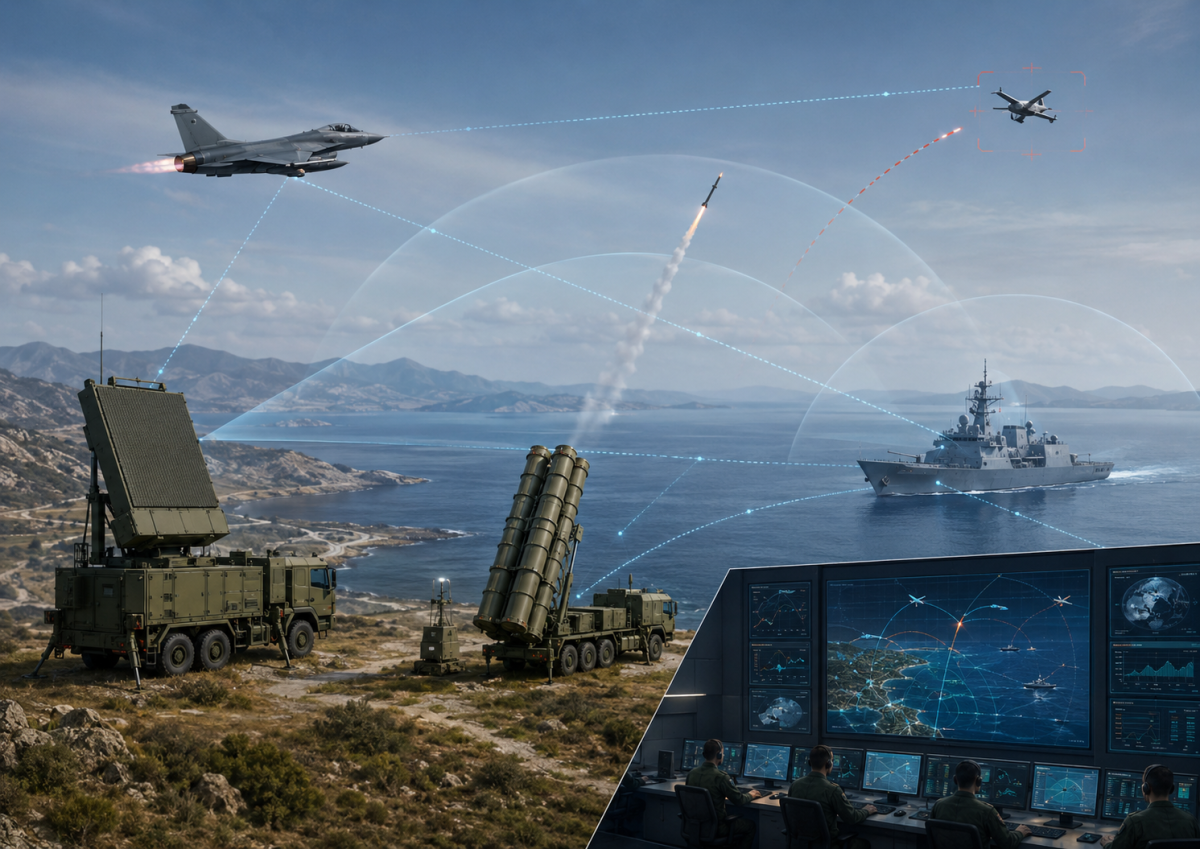
NATO now describes integrated air and missile defence as a capability covering the full spectrum of aerial threats, from drones to ballistic and hypersonic missiles. This shift calls for a distributed architecture: fixed and mobile radars, optronic sensors, air-defence frigates, fighter aircraft, short-, medium- and long-range ground-to-air systems, electronic warfare assets and interoperable C2 centres. (NATO)
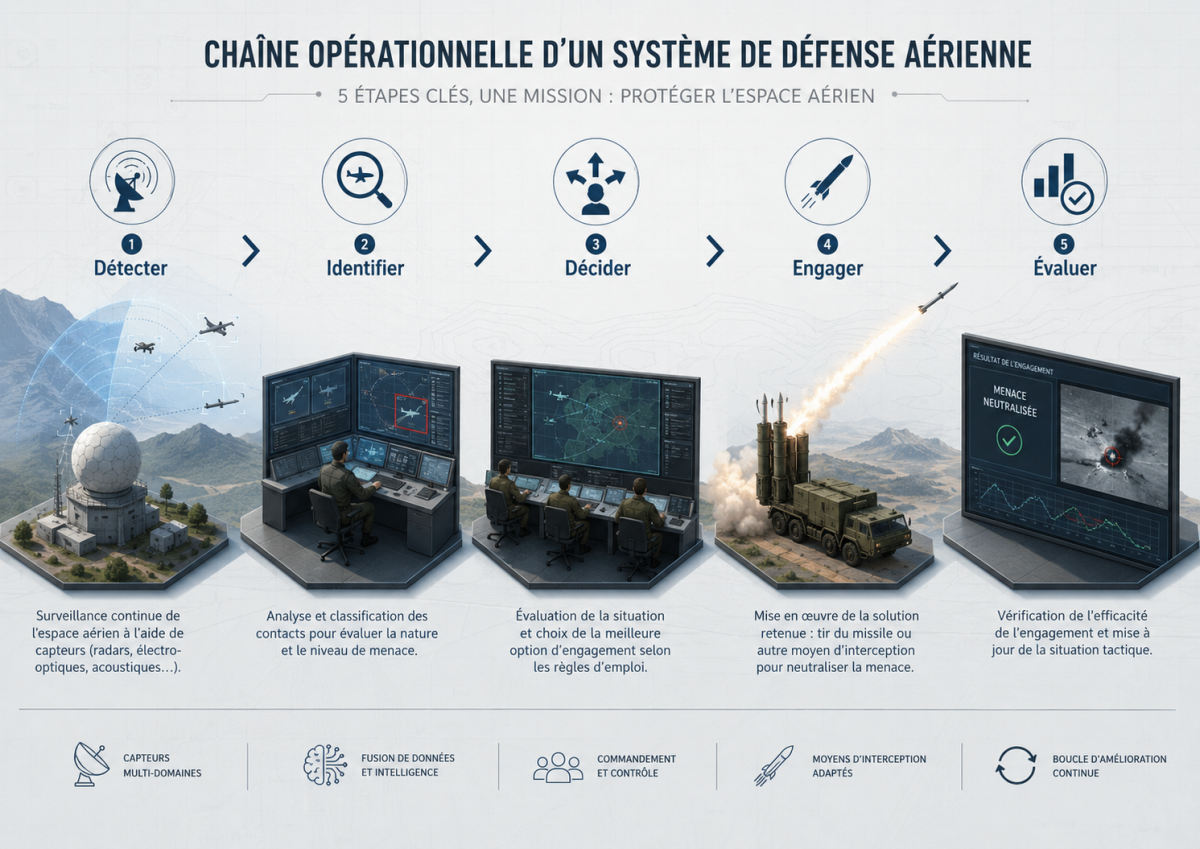
The challenge, therefore, is not only to have high-performance sensors or effectors. It is about fusing heterogeneous data, prioritising threats, avoiding redundant shots, preserving communications and maintaining controlled decision-making within a very short timeframe. At European level, initiatives such as the European Air Shield and the European Drone Defence Initiative, set out in the European defence roadmap to 2030, reflect this search for a coordinated response. The naval dimension plays a structuring role: a surface combatant can extend the detection bubble, protect a coastal area and share its tracks with land and air assets. (Defence Industry and Space)
Saturation changes the industrial equation
Recent conflicts have confirmed a key point: a credible defence must be able to absorb saturation. A low-cost drone can force the use of a far more expensive interceptor; a salvo may seek to exhaust stocks; a combined attack can mix decoys, jamming and multiple trajectories. For industry, the challenge becomes twofold: increase performance, but also reduce unit cost, simplify maintenance and accelerate production.
This directly brings up ramp-up, supply chain and obsolescence issues. Electronic sub-assemblies, computers, FPGA boards, power supplies, antennas, actuators, data links and test benches must be secured over time. Qualification chains must also keep pace: environmental testing, EMC, software validation, embedded cybersecurity, component qualification and technical documentation usable for in-service support (MCO). This industrial robustness determines real availability: a high-performance system that is difficult to maintain, test or supply weakens the entire posture.
Innovative solutions, but qualified
The expected innovation is not limited to interceptors. It also concerns multifunction radars, data fusion, decision-support AI, open architectures, directed-energy effectors, counter-drone solutions, digital twins and simulation capabilities. The objective is clear: detect earlier, decide faster, engage at the right cost and reconfigure systems in the face of evolving threats.
It is precisely on these engineering building blocks that Ametra and its partners can contribute: mechanical and electronic design, equipment industrialisation, software development, cybersecurity, test benches, system validation, documentation, configuration management and life-cycle support. Recent posts on the Ametra blog about future defence programmes also remind us that meaningful autonomy depends less on an isolated object than on coherence between sensors, payloads, links, command and support. (Ametra Group)
Conclusion: building technological endurance
For Europe, air defence has become an issue of industrial sovereignty as much as security. The answer will not come from a single system, but from a coherent, interoperable and sustainable set, capable of operating from the ground, the air and the sea. In this context, the value of engineering lies in execution: turning innovation into qualified capabilities, produced at a controlled rate and sustained over time.
To learn more about Ametra Group’s expertise and our references, visit our official website. We are also on LinkedIn!