©PhotoPQR/Le Télégramme/Lionel Le Saux
Through the modernization of its two components, airborne and oceanic, French nuclear deterrence highlights a major industrial reality: strategic sovereignty also relies on France’s ability to design, qualify, produce, and maintain extremely complex systems over the long term.
Two Carriers, One Industrial Requirement
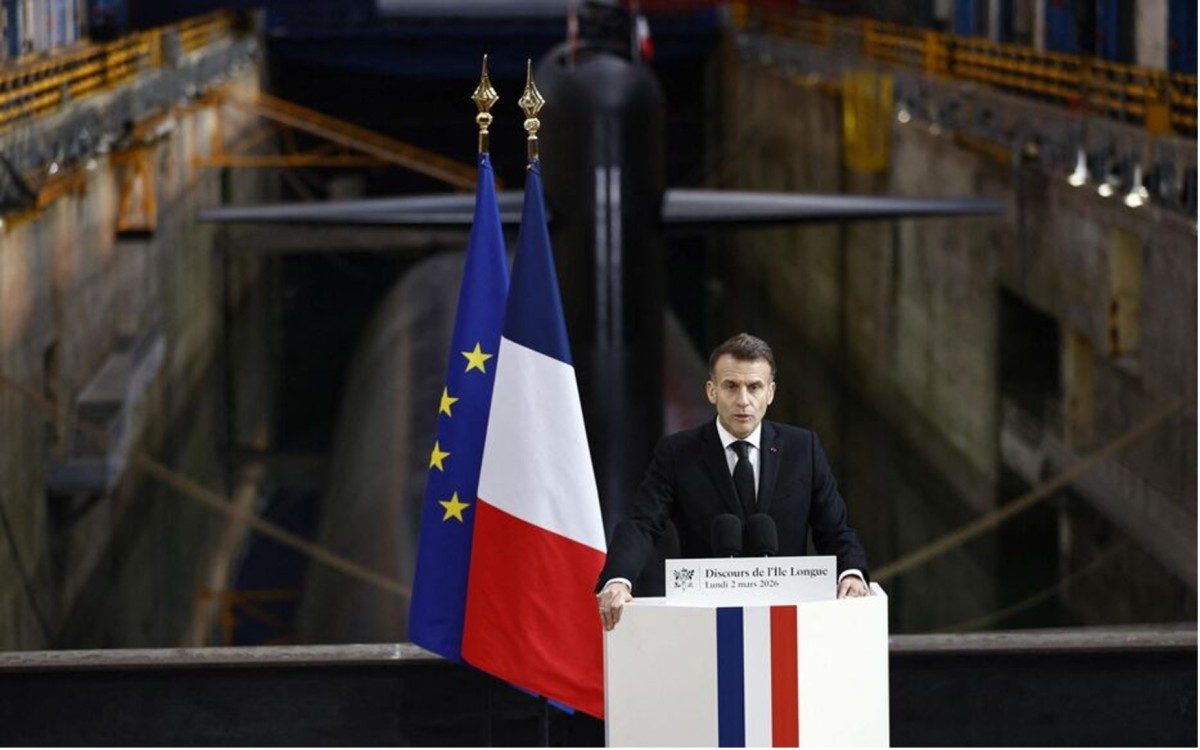
The speech of March 2, 2026, by the President of the Republic on French nuclear deterrence underscores an essential reality: the credibility of this deterrence rests not only on a doctrine but on a very high level of industrial capability, sustained over time. For defense stakeholders, the message is clear: French strategic sovereignty is also a matter of engineering, production, and operational readiness maintenance[AD1] and technological continuity.
This deterrence continues to rely on two carriers. On one side, the airborne component, implemented by the Rafale. On the other, the oceanic component, ensured by the nuclear-powered ballistic missile submarines (SSBNs). This two-component model imposes an exceptional requirement for reliability, availability, and technical mastery for systems among the most complex in the BITD (Defense Industrial and Technological Base).

Rafale in “Air-to-Air” configuration © Dassault Aviation – K. Tokunaga
On the aerial side, the Rafale is much more than a combat aircraft. It is one of the vectors of French sovereignty, which implies an entire industrial fabric behind it: embedded electronics, critical software, system integration, testing, qualification, technical documentation, support, and configuration evolution. In this type of program, performance is not only achieved in flight; it is also built on the robustness of industrial processes and the quality of technical data.

The future nuclear-powered ballistic missile submarine (SNLE 3G) © Naval Group
The same logic applies to the oceanic component, with even greater intensity. SSBNs embody the permanence of deterrence, and thus excellence over the long term: safety, equipment qualification, supply chain resilience, interface mastery, maintenance rigor, and skill transfer. The modernization of these systems confirms that deterrence remains, for France, a structuring industrial policy as much as a military capability.
A BITD Mobilized Across the Entire Supply Chain
For the BITD, the implications are direct: increased needs in system engineering, electronics, embedded software, testing, simulation, industrialization, document management, and supply chain security. In other words, the credibility of deterrence depends as much on major prime contractors as on the depth of the supply chain: mid-sized companies, SMEs, design offices, integration and support specialists.
This is also what makes this subject particularly revealing of current industrial challenges. The ramp-up of defense programs, for example, is never just about producing more; it requires making documentation more reliable, processing evolutions faster, managing obsolescence, and preserving quality as volumes increase (see on this topic: Thales LAS: Supporting the Industrial Challenge of “Ramp-Up” and Sovereignty).
Regarding the aeronautical component, the technological transformation challenges are equally structuring: increasing architectural complexity, intensifying computing needs, evolving embedded systems, and growing hybridization between industrial performance and digital innovation (see on this topic: Industrial Ramp-up and Artificial Intelligence: What Le Bourget 2025 Revealed).
Beyond Strategy, a Challenge of Technical Mastery
On the naval side, the question is equally concrete: in highly critical environments, qualification, testing, and execution precision become absolute conditions for performance. This directly relates to the challenges of functional dimensioning, dimensional rigor, and quality control in the most demanding naval programs (see on this topic: Functional Dimensioning Training at Naval Group Indret).
Ultimately, French nuclear deterrence highlights a simple industrial truth: the most strategic capabilities are also those that demand the highest level of technical mastery, continuity of skills, and execution discipline. Behind major programs, entire chains of expertise must remain robust, synchronized, and sovereign.
In this sense, French deterrence remains a matter of strategy. But it is, equally, a matter of engineering, production, and industrial mastery. For industry players, including Ametra, it underscores a permanent requirement: to preserve over time the skills, methods, and capabilities that make France’s strategic autonomy possible.
Visit the official Ametra Group website to learn more, and don’t forget to follow us on LinkedIn so you don’t miss any of our news!
[/et_pb_text][/et_pb_column][/et_pb_row][/et_pb_section]