In engineering professions, recruiting is not simply about filling a position. It requires identifying technical skills, understanding a project environment, evaluating interpersonal abilities, and ensuring sustainable integration. In this context, employee referrals provide a simple and effective solution: mobilizing employees as trusted intermediaries to attract better-targeted profiles.
Better Qualified Sourcing from the Start
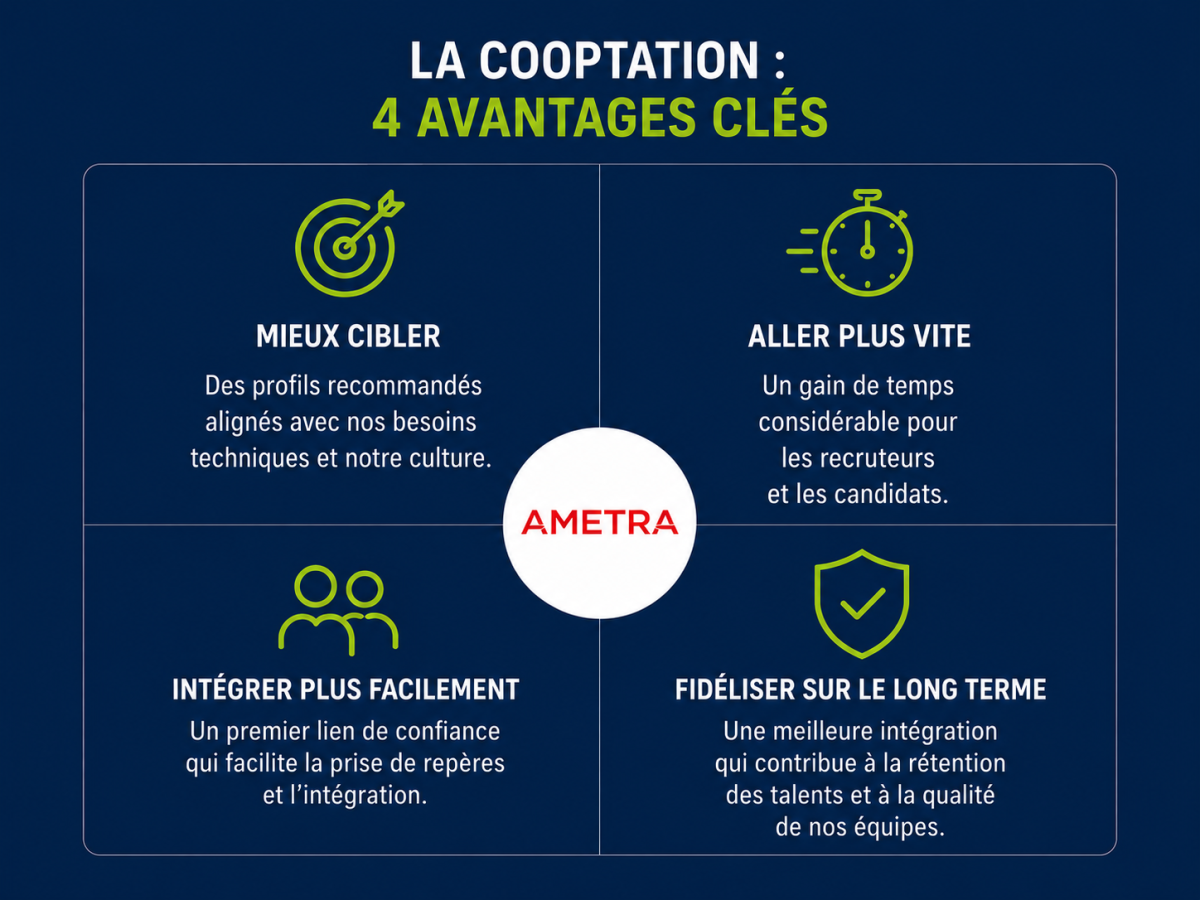
Employee referrals are based on a clear principle: an employee recommends a person whose background, skills, or potential they know. For an engineering firm like AMETRA, this recommendation holds particular value. Employees understand what teams expect: technical rigor, ability to work in project mode, understanding of client constraints, as well as motivation, professional demeanor, and alignment with company culture.
The recruiter therefore receives a pre-qualified profile. This does not replace HR evaluation or technical interviews, but it improves the relevance of the entry point. In a market where the low number of applications remains a major challenge for executive recruitment, mobilizing professional networks remains an important channel, as highlighted by the 2025 Apec barometer.
Accelerating Without Compromising Quality
The main operational advantage is time savings. A referred candidate arrives with an initial level of information: why this profile is relevant, in what context they were known, which skills may match the need. For the recruiter, this allows focusing discussions on validating the professional project, key skills, and alignment with the assignments.
This speed also benefits candidates. Executives expect greater clarity, reciprocity, and concrete information about the work environment, according to a 2024 Apec study on executive expectations. Employee referrals partially address this expectation: the candidate already has an internal contact capable of explaining the reality of projects, team atmosphere, and working methods.
Faster Integration, More Sustainable Retention
Employee referrals also impact integration. Joining a company while already knowing someone facilitates initial orientation: understanding teams, asking questions, decoding practices, identifying the right contacts. This proximity contributes to a smoother work environment, as the referrer also stakes their credibility on the recommendation.
For industrial professions, this human dimension is essential. Performance does not rely solely on individual expertise; it depends on the ability to integrate into a project team, share information, meet milestones, and contribute to execution quality. This is also what helps preserve skills continuity, a central issue in activities where innovation, simulation, and industrialization require time. AMETRA articles on TPMS structures and on the carbon footprint of engineering firms demonstrate how engineering combines technical expertise, methodology, and responsibility.
Sustaining the Program Over Time
To function effectively, employee referrals must be visible, understood, and actively promoted. At AMETRA, the program is presented during the recruitment process, reinforced during agency meetings, and highlighted in campus recruitment activities. The presence of ambassadors—former interns or apprentices who became employees—creates a very concrete connection with students: testimonials make the company more accessible.
The program is also supported by a referral bonus, adjusted according to the experience of the recommended person, and by periodic challenges where this bonus is increased. The issue is not solely financial: it is about recognizing employees’ commitment to building teams. Thus, employee referrals represent nearly 15% of hires at Ametra, a true mark of confidence from our teams!
To learn more about Ametra Group’s expertise and our references, visit our official website. We are also on LinkedIn!