What is the connection between soap bubbles and Triply Periodic Minimal Surfaces, more commonly known as TPMS structures?
In the 18th century, physicists and mathematicians studying the potential energy of a soap film sought to determine the equations governing their surfaces (Figure 1-a). In this context, the catenoid was the first minimal surface identified and discovered by Leonhard Euler in 1744 (Figure 1-b) [1].
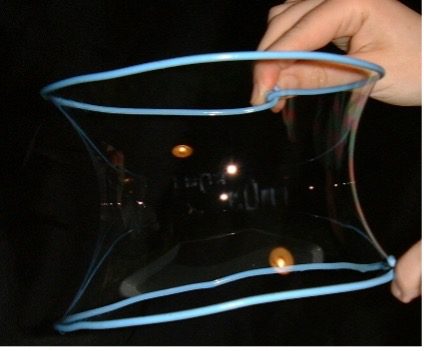
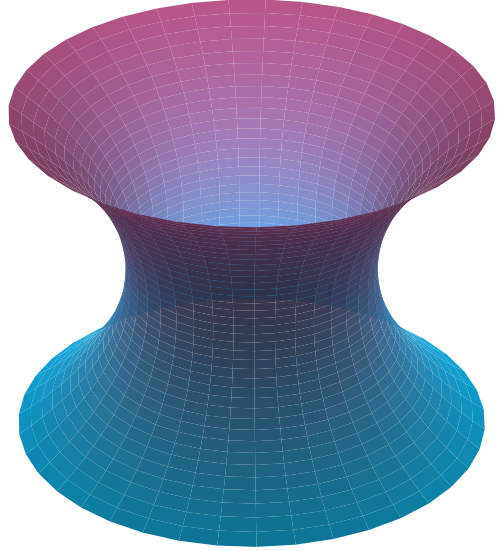
Figure 1 a) Photo of a soap film materializing a catenoid, b) representation of a catenoid created with Python
In this framework, the study of soap films led to the development of minimal surface equations. The search for periodic solutions to these equations, under specific boundary conditions, allowed for the identification of the first Triply Periodic Minimal Surfaces (TPMS) in the 19th century. These include the Primitive (P-Schwarz) and Diamond (D-Schwarz), discovered by Hermann Schwarz [2], the Neovius surface by Edvard Neovius [3], as well as, later, the Gyroid and IWP identified by Alan Schoen [4].
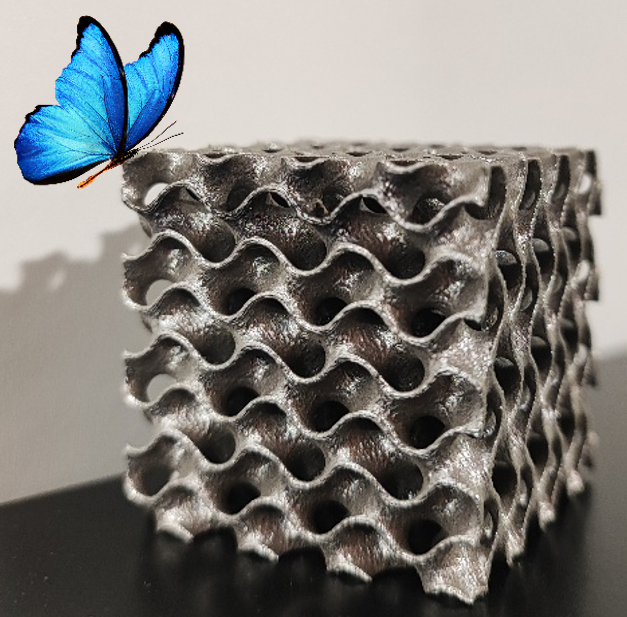
As their name suggests, they are triply periodic: they can be duplicated in all three spatial directions, thus creating a regular network reminiscent of a foam structure. Other structures have since been discovered, but the most studied are those mentioned above (Figure 2).
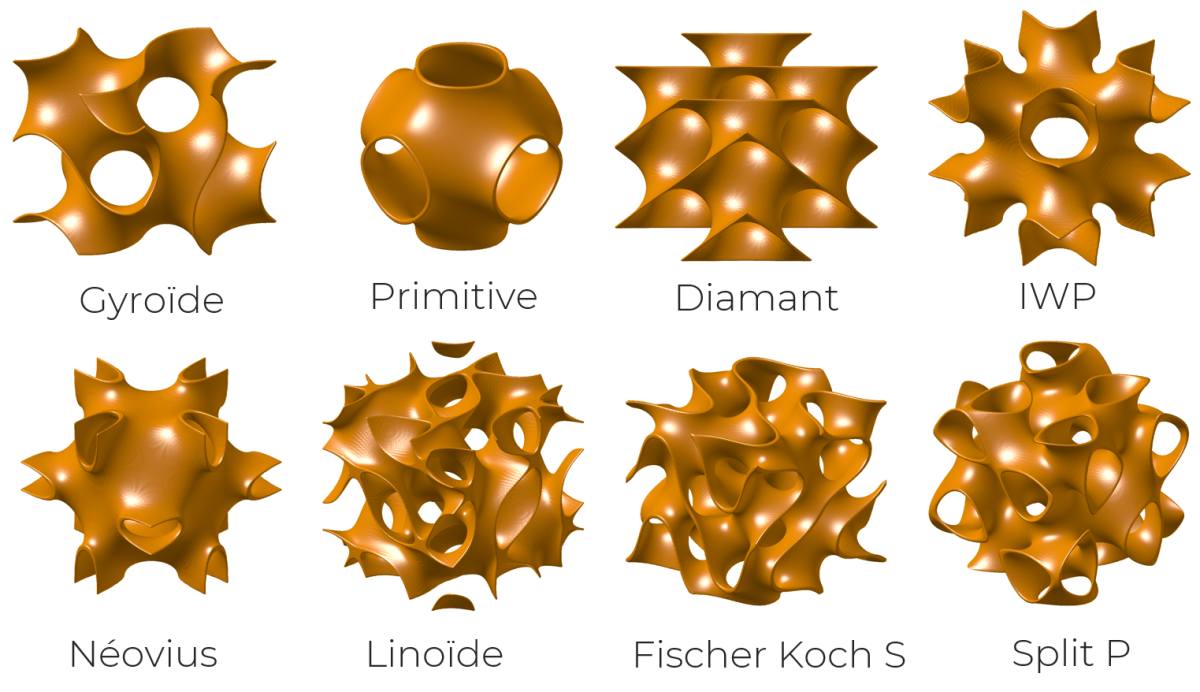
Figure 2 Cells of TPMS structures generated via Altair Inspire suite
Beyond the physical model, what is the interest in studying these TPMS structures?
Complex three-dimensional architectures derived from TPMS are also found in the animal kingdom. These structures, observed in various biological systems, combine lightness, rigidity, and mechanical or functional efficiency.
TPMS-type architectures have notably been identified in:
The weevil’s exoskeleton: diamond structure (Figure 3-c), optimizing rigidity and resistance to mechanical stress [5].
Butterfly wings: gyroid structure (Figure 3-a), contributing to both lightness and optical properties [5],
The sea urchin’s skeleton: primitive structure (Figure 3-b), offering high mechanical resistance for low mass [6],
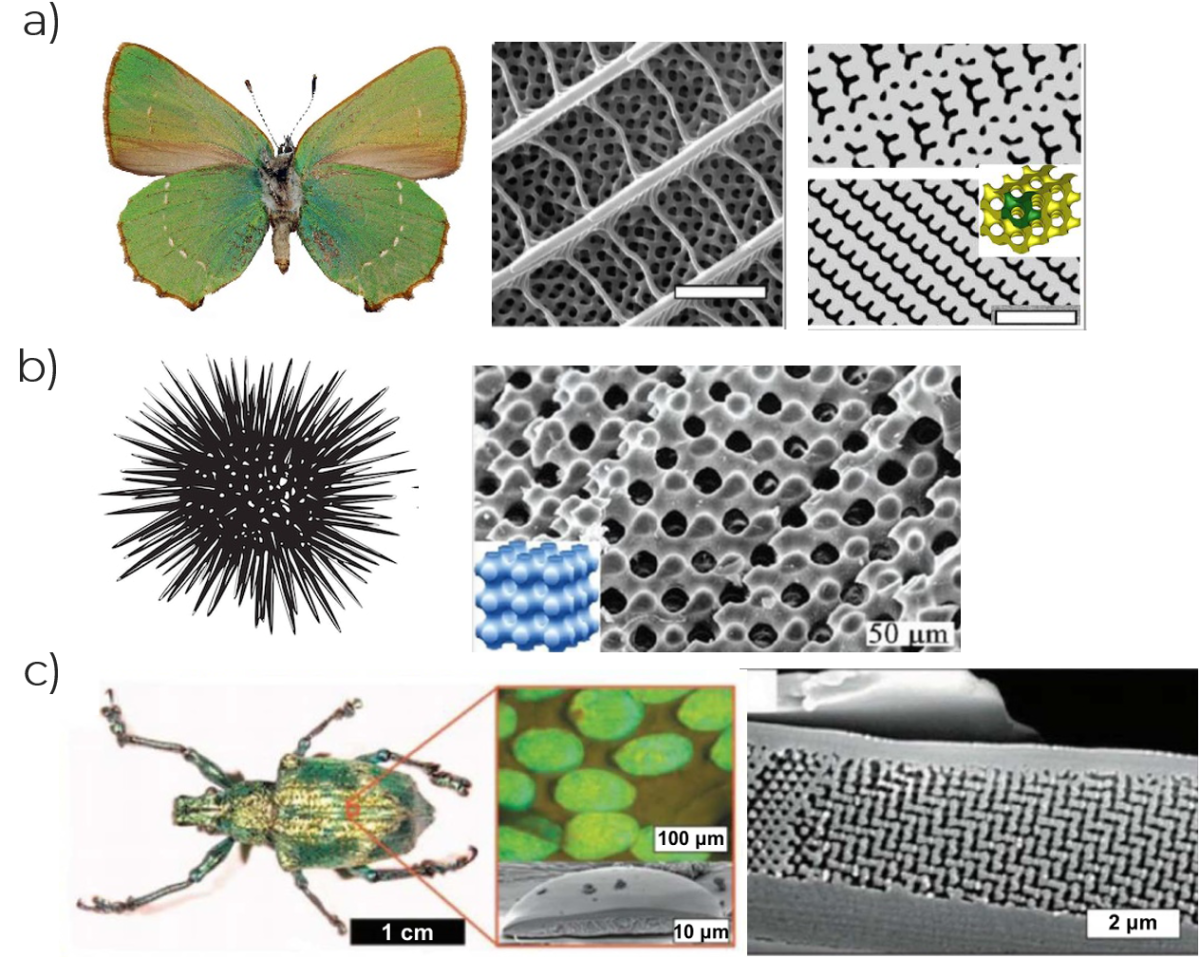
Figure 3 a) butterfly wings; b) Sea urchin bone structure; c) Weevil shell
TPMS structures are not materials in themselves, but architectures. When combined with a given material (metal, polymer, composite, etc.), they become the basis of metamaterials (from Greek meta: beyond): artificial materials whose properties primarily derive from their structure.
Thanks to these architectures, it is possible to design materials with tailor-made performance:
- Lightweight and resistant mechanical structures,
- Materials with controlled thermal conduction,
- Surfaces with specific optical properties,
- Or even multifunctional materials.
A well-known example of an architectural metamaterial is the honeycomb structure, widely used in aeronautics and automotive industries: its exceptional rigidity comes not from the material, but from its geometry.
Why is AMETRA Engineering’s R&D unit interested in TPMS structures?
TPMS structures exhibit particularly interesting performance, especially in mechanics and thermal management.
Several studies have shown that these architectures are capable of effectively absorbing dynamic mechanical stresses, such as shocks or impacts, often better than conventional structures used in engineering [7].
Their continuous and interconnected geometry also promotes more homogeneous thermal dissipation, making them relevant candidates for applications subject to significant heat fluxes [8].
However, the final performance of a TPMS structure does not depend solely on the chosen geometry. Other parameters play a key role, such as cell size, relative density, scale effects, and the manufacturing process, which directly influences geometric precision and the properties of the final material.
Let’s talk about the manufacturing process: how are TPMS structures obtained?
TPMS structures feature continuous, highly interconnected internal geometries without simple separation surfaces. These characteristics make their fabrication extremely difficult, if not impossible, by conventional processes such as casting, forging, or machining, which rely on accessible tools, molds, or machining paths.
Additive manufacturing, which builds the part layer by layer from a digital model, on the contrary, allows for the fabrication of these complex architectures without tooling constraints. It thus opens the way for the concrete realization of TPMS structures, previously limited to theoretical or numerical studies.
Although additive manufacturing allows for the creation of TPMS structures, it nevertheless leads to significant variability in the final material properties.
A review of several literature articles reveals that, for an identical material like 316L steel, parameters such as Young’s modulus can show fluctuations, with the latter varying, for example, between 145 and 210 GPa [9], [10], [11], [12], [13], [14].
This dispersion is mainly attributed to the impact of the additive manufacturing process and its various parameters (technology used, printing conditions, post-treatment, etc.). Consequently, the AISI 316L standard cannot be considered representative of the mechanical properties of TPMS structures obtained by additive manufacturing.
In this context, how can we ensure that the results from finite element simulation correspond to reality?
Since the mechanical properties of a 316L steel TPMS structure can vary significantly from one additive manufacturing process to another, it is important to perform experimental mechanical stress tests (compression) and then apply an inverse method to determine the material parameters specific to a type of process, a type of structure, and a type of material. Simulation results will only be guaranteed in this scenario and not for another process.
It is in this context that AMETRA Engineering’s R&D unit has established a partnership with the Multi-physics Multi-scale Mechanics Laboratory (LaMcube, CNRS UMR9013) based at Centrale Lille engineering school. The laboratory ensures the additive manufacturing of TPMS structures as well as the execution of experimental compression tests, which are essential for validating numerical models [15].
How to predict the mechanical performance of a TPMS structure using compression simulations?
To successfully conduct finite element simulations, it is not enough to know the material parameters and the manufacturing process; one must first generate the geometry and mesh it. This procedure consists of discretizing the structure into small finite elements, on which mechanical equations are solved. Due to their triply periodic geometry and continuous surface, TPMS structures can be meshed homogeneously. However, the complexity of their geometry often leads to the use of excessively fine or irregular elements, which can increase computation time and lead to numerical errors. A preliminary mesh sensitivity study is therefore essential for this type of structure.
What would be the applications of TPMS structures?
Mechanically, TPMS structures are lightweight structures capable of absorbing shocks more effectively than conventional structures currently used in industry. They could thus find applications in energy absorption for civilian or military vehicles.
These structures could also find applications in the field of personal protective equipment, such as bicycle or motorcycle helmets. Furthermore, they show strong potential for protecting electric vehicle batteries, typically positioned at the bottom of the chassis. Beyond their shock absorption function, TPMS structures could contribute to the thermal dissipation of batteries, thereby limiting the risk of overheating.
We will detail the thermal study of TPMS structures in a future article.
[1] L. Euler, Methodus inveniendi lineas curvas: maximi minimive proprietate gaudentes sive solutio problematis isoperimetrici latissimo sensu accepti, Bernae: Auctoritate et Impensis Societatis scientiarum naturalium Helveticae. 1952. [Online]. Available at: https://archive.org/details/methodusinvenie00eule/page/n3/mode/2up
[2] H. A. Schwarz, Gesammelte Mathematische Abhandlungen. Springer-Verlag Berlin Heidelberg, 1890. [Online]. Available at: https://gallica.bnf.fr/ark:/12148/bpt6k99467c.image
[3] E. R. Neovius, Bestimmung zweier speciellen periodischen Minimalflächen, auf welchen unendlich viele gerade Linien und unendlich viele ebene geodätische Linien liegen, Helsingfors: Frenckell. 1883. [Online]. Available at: http://resolver.sub.uni-goettingen.de/purl?PPN591417707
[4] A. H. Schoen, “Infinite Periodic Minimal Surfaces Without Self-intersections,” U. S. Natl. Aeronaut. Space Adm., vol. Technical Report NASA-TN-D-554, 1970, [Online]. Available at: https : / / ntrs . nasa . gov / archive/nasa/casi.ntrs.nasa.gov/19700020472.pdf
[5] L. Han and S. Che, “An Overview of Materials with Triply Periodic Minimal Surfaces and Related Geometry: From Biological Structures to Self‐Assembled Systems,” Adv. Mater., vol. 30, no 17, p. 1705708, Apr. 2018, doi: 10.1002/adma.201705708.
[6] T. Yang, Z. Wu, H. Chen, Y. Zhu, and L. Li, “Quantitative 3D structural analysis of the cellular microstructure of sea urchin spines (I): Methodology,” Acta Biomater., vol. 107, p. 204‑217, Apr. 2020, doi: 10.1016/j.actbio.2020.02.034.
[7] G. Feng, S. Li, L. Xiao, and W. Song, “Mechanical properties and deformation behavior of functionally graded TPMS structures under static and dynamic loading,” Int. J. Impact Eng., vol. 176, p. 104554, Apr. 2023, doi: 10.1016/j.ijimpeng.2023.104554.
[8] M. G. Gado, S. Ookawara, and H. Hassan, “Utilization of triply periodic minimal surfaces for performance enhancement of adsorption cooling systems: Computational fluid dynamics analysis,” Energy Convers. Manag., vol. 277, p. 116657, Feb. 2023, doi: 10.1016/j.enconman.2023.116657.
[9] S. AlMahri et al., “Evaluation of the dynamic response of triply periodic minimal surfaces subjected to high strain-rate compression,” Addit. Manuf., vol. 46, p. 102220, Oct. 2021, doi: 10.1016/j.addma.2021.102220.
[10] N. Novak et al., “Impact loading of additively manufactured metallic stochastic sheet-based cellular material,” Int. J. Impact Eng., vol. 174, p. 104527, Apr. 2023, doi: 10.1016/j.ijimpeng.2023.104527.
[11] C. Zhang et al., “Vibration characteristics of additive manufactured IWP-type TPMS lattice structures,” Compos. Struct., vol. 327, p. 117642, Jan. 2024, doi: 10.1016/j.compstruct.2023.117642.
[12] N. Qiu, Y. Wan, Y. Shen, and J. Fang, “Experimental and numerical studies on mechanical properties of TPMS structures,” Int. J. Mech. Sci., vol. 261, p. 108657, Jan. 2024, doi: 10.1016/j.ijmecsci.2023.108657.
[13] Y. Lyu, T. Gong, T. He, H. Wang, M. Zhuravkov, and Y. Xia, “Study on the Energy Absorption Performance of Triply Periodic Minimal Surface (TPMS) Structures at Different Load-Bearing Angles,” Biomimetics, vol. 9, no 7, p. 392, June 2024, doi: 10.3390/biomimetics9070392.
[14] A. M. Abou-Ali et al., “Impact Damage Behavior of Additively Manufactured Stainless Steel Triply Periodic Minimal Surface-Lattice Composite Sandwich Panels,” ES Mater. Manuf., 2025, doi: 10.30919/mm1461.
[15] A. El Hanafi, P. Lubin, and C. Mauc, “A preliminary study on TPMS metamaterials structures,” 2025.
To learn more, visit the Ametra Engineering website now. We are also on LinkedIn!